Institute of Slavic Studies of the Russian Academy of Sciences
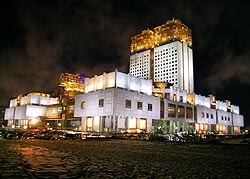
The Institute of Slavic Studies of the Russian Academy of Sciences is an integral part of the Historical and Philological Studies Department of RAS. It is a unique Russian academic institution focused on comprehensive studies on Slavic history, culture, literature and languages. The Institute carries on traditions of the Russian Slavic scholars evolving through the last two centuries.
The Institute was established in January 1947 with the direct involvement of such distinguished figures in Slavistics as academicians B. D. Grekov and V. I. Picheta. Amongst the members of the Institute were academicians J. V. Bromley, N. S. Derzhavin, V. A. Dybo, Vyach. Vs. Ivanov, G. G. Litavrin, D. F. Markov, L. V. Milov, S. P. Obnorsky, J. A. Pisarev, M. N. Tikhomirov, N. I. Tolstoy, V. N. Toporov, O. N. Trubachev, associates T. M. Nikolaeva, P. N. Tretyakov, Z. V. Udaltsova, V. K. Volkov and A. A. Zaliznyak; the academician of Russian Academy of Education S. O. Shmidt. Now amongst the members of the Institute are academicians of RAS A. A. Gippius, S. M. Tolstaja, associates of RAS B. N. Florya, S.A. Myznikov.
From October 1968 to December 1997 the Institute was known as the Institute of Slavic and Balkan Studies. Since June 1, 2008 the Institute is officially referred to as the Russian Academy of Sciences Institute of Slavic Studies.
At present the Institute is headed by V.L. Klyaus.
More than 170 research scientists including about 70 doctors of Science and more than 70 masters of Science contribute to the successful performance of the Institute.
The Institute consists of 12 departments and 6 scientific centers.
The Institute issues its own journal Slavyanovedenie, a unique Russian scientific periodical dedicated to Slavic history, culture, literature and languages.
Principal lines of research in the Institute of Slavic Studies
- Theoretical principles of archaeography and their practical application in the study of the history of Slavic peoples and the archival heritage of Russian Slavists
- Nations, confessions, and cultural communities of Central, Eastern, and Southeastern Europe from the Late Middle Ages to the present day: the experience of interaction and the lessons of confrontation
- Forms and boundaries of vertical and horizontal mobility of individuals and social groups in multi-ethnic and mono-ethnic communities in the 18th–20th centuries
- Modern and Contemporary history of Central, Eastern, and Southeastern European countries: revolutions and reforms, wars, regionalism and Europeanization, the formation of international security systems
- Slavic and non-Slavic languages and dialects in comparative-historical, ethnolinguistic, sociolinguistic, and typological aspects: history and modernity
- Languages and cultures within the space of Slavia: traditions and innovations
- Comparative-typological study of the literature and culture of the Slavs and their neighbors in synchrony and diachrony
Address of the Institute of Slavic Studies RAS
119334 Moscow, Leninsky Prospect, build. 32-А
Phone: +7 (495) 938-17-80 (administrative office)
Fax: +7 (495) 938-00-96
To enter the building of RAS you are required to order a pass and have a passport to show.
Administration
Vladimir L. Klyaus
Director
+7 (495) 938-17-80
Elena S. Uzeneva
Deputy Director for Scientific work (Philological departments)
+7 (495) 938-19-01
Olga V. Khavanova
Deputy Director for Scientific work (Historical departments)
+7 (495) 938-18-94
Nikita S. Gusev
Academic Secretary
+7 (495) 938-17-96
The website of the Institute of Slavic studies was launched in 2005, redesigned in 2009 and 2017. It regularly places the news and reports on the Institute performance, including the announces of new publications, information on conferences, theses defenses and other events. In 2010 the website introduced the Digital Library to encourage the visitors to read and download materials published by the Institute.
From the date of its foundation the Institute provides the applicants with postgraduate studies. According to the license issued by the Federal Education and Science Supervision Agency, the Institute is entitled to carry on educational activities on postgraduate professional studies with following specialization: «General History» (specialization no. 07.00.03), «Literature of foreign countries» (10.01.03) and «Slavic languages» (10.02.03).